BENDIGO GEOLOGICAL ZONE
Three distinct gold forming events
The Wedderburn Goldfield sits near the western margin of Victoria’s Bendigo geological structural zone. The zone experienced three distinct gold-forming events: 445, 410, and 370 million years ago, and has the greatest gold production of all Victorian geological zones, totalling more than 65 million ounces. It contains most of the state’s 7,000 historical gold mines in major mining centres such as Bendigo, Ballarat, Castlemaine and Clunes, and the significant modern gold production centre at Fosterville.
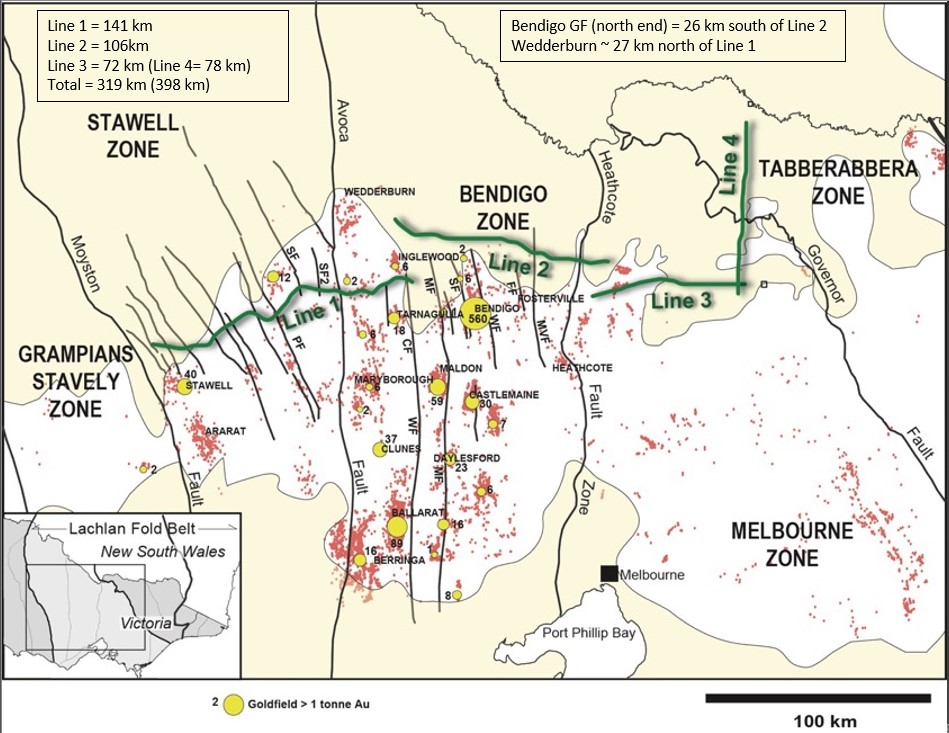
In 2006 a 319 km long Seismic Survey, was conducted along three overlapping lines in an east-west direction across Victoria. This historic event gave Victorian geologists an image of Victoria’s deep crust for the first time.
Folding
In the 160 years of Victorian gold exploration prior to the seismic survey, geologists understood that north-south trending folds in Palaeozoic turbidites were the major structural controls at the mine and goldfields scale.
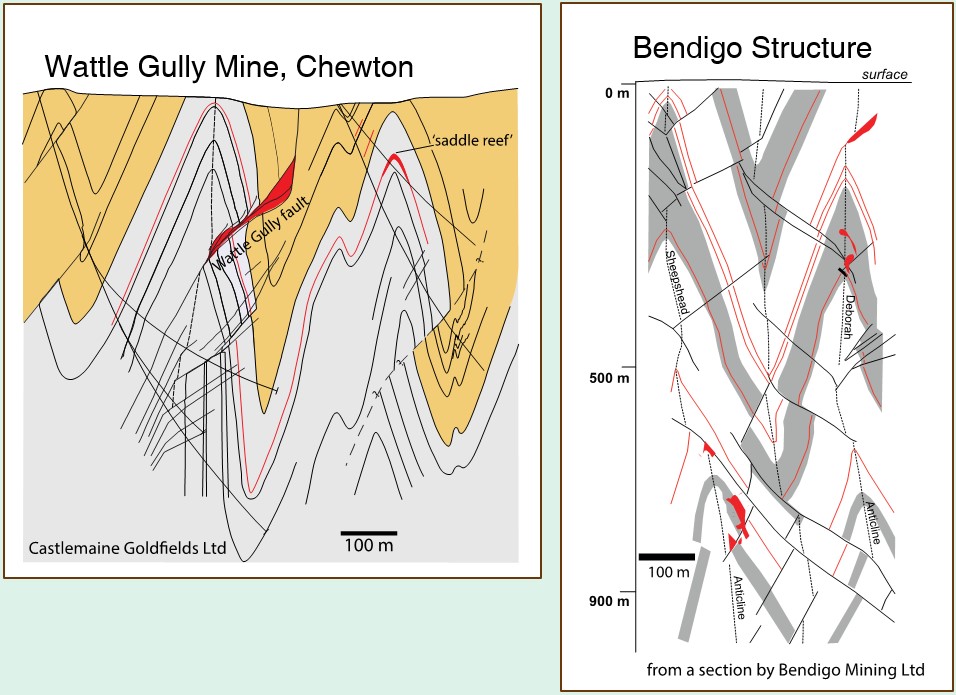
Their theories for this strong relationship between folds (and/or bedding) and mineralised lodes were simple. Bedding-parallel laminated veins (LQs) formed early and were folded about fold hinges and very often, limb thrusts were propagated from along these early structural weaknesses, to then cut across the host fold hinge. Saddle reefs at Bendigo formed in this way, Wattle gully is classic variant of this style and even Fosterville seems to be related to this type of limb thrust geometry.
Wedderburn is Typical
Wedderburn is no different. There we have classic bedding-parallel veins, folded about anticlines. There are limb thrusts in the Lanes Reef deposit that cut across a fold hinge, very similar to elsewhere in Victoria. Mineralised limb thrusts are directly related to folds and are generated by fold tightening. Folds are fundamental structures. At Bendigo and Castlemaine, where the most detailed mapping exists, folds can be traced for many kilometres along strike.
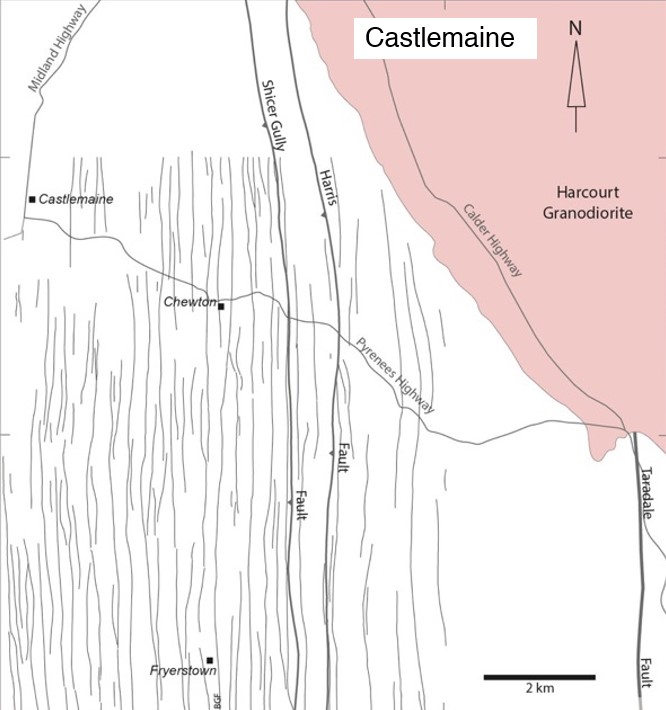
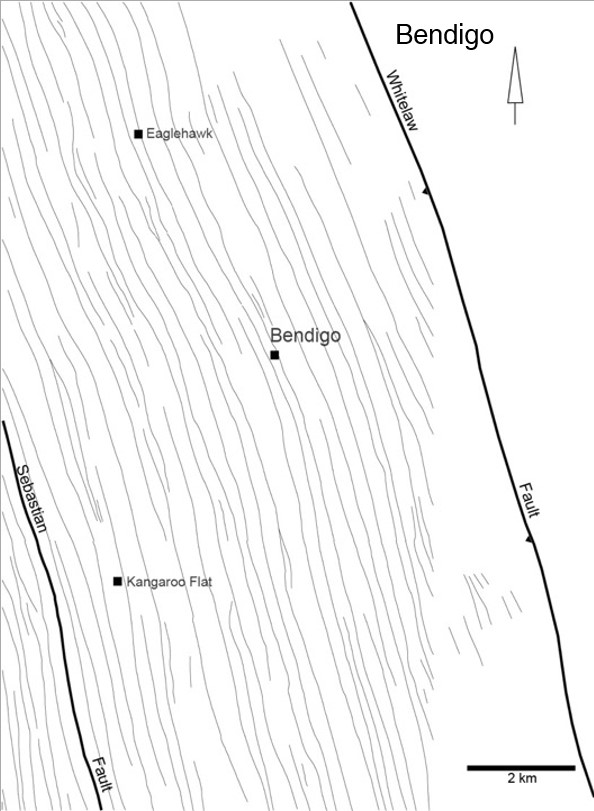
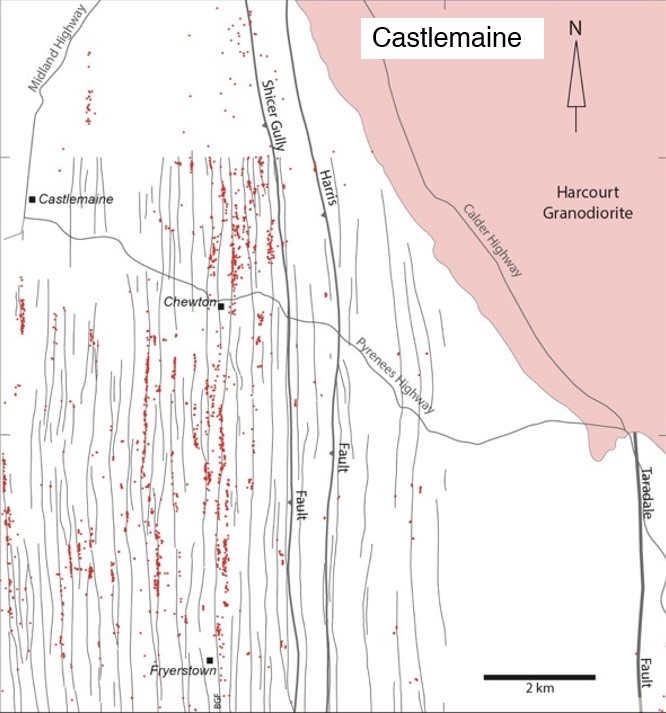
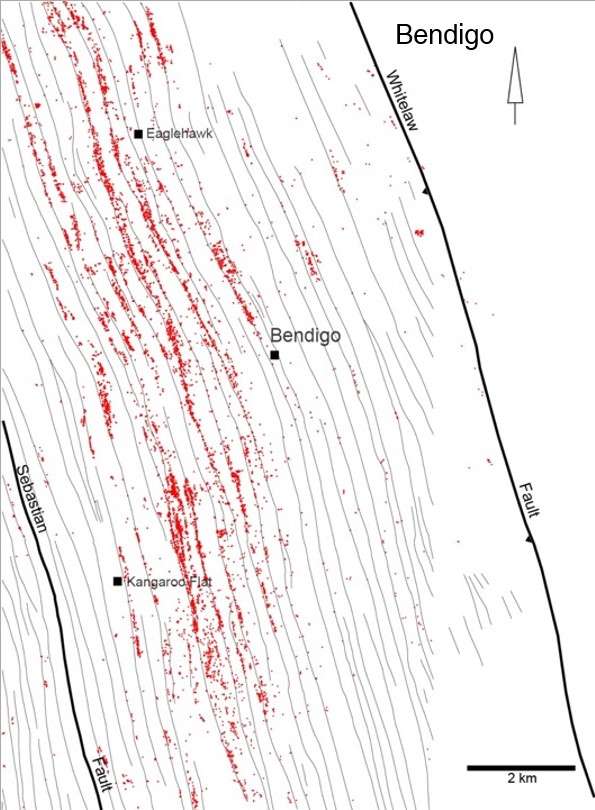
By overlaying the distribution of shafts, the extraordinary relationship between folds and mineralisation is apparent. At Bendigo some individual folds are mineralised, discontinuously, for some 15 kilometres along strike. At Castlemaine it’s up to eight kilometres. The main mineralised belt in the East Ballarat Goldfield is 14 km along strike but only 500 metres wide.
Why aren’t gold deposits evenly distributed?
Folds are everywhere across the Bendigo zone – so if mineralisation is solely dependent on folds for structural control, why aren’t goldfields evenly spread across the zone?
Instead, gold deposits are clustered into what is known as a goldfield. Each goldfield is usually hosted by a set of a few anticlines, and therefore deposits are stretched out along strike – each goldfield is separated by eight to thirty kilometres of un-mineralised folded Ordovician turbidites, with no clear or obvious differences in fold geometry
Clearly there is a larger-scale structural control imposed on the area that makes some folds, or groups of folds, important traps for mineralisation while others are left barren.
Goldfield Formation Theories
The first attempt to explain the spacing of goldfields was by Professor Stephen Cox in about 1983 – 23 years before the seismic survey.
Professor Cox hypothesised that the location and spacing of gold deposits in the Bendigo Zone are related to major intrazonal faults. He speculated that these major faults channelled fluids to some areas and not others because the spacing of major faults is similar to the spacing of the goldfields.
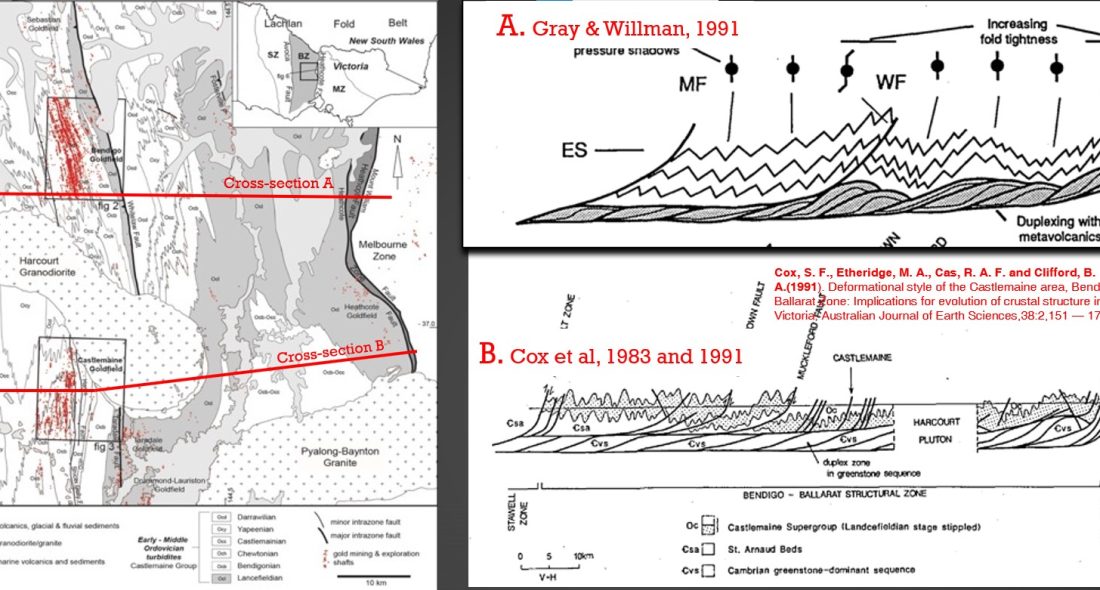
At the same time other geologists like Dr David Gray and Clive Willman MSc speculated that the Bendigo and Stawell zones were underlain by Cambrian volcanics. So the structural models in which major intrazonal faults, like the Whitelaw, Muckleford, Campbelltown faults, were listric in profile and would flatten at depth. In 1988 Dr Gray reasoned that the Cambrian volcanics that form the fault slices at Heathcote would underlie the whole region – although others had probably already arrived at that conclusion.
But it was Professor Cox that first suggested the listric shaped faults might form the plumbing system that dictated where gold deposits in the upper crust would form – although he suggested that it might be blind thrusts that feed the goldfield (this is because the thrusts at the surface are all not-mineralised).
If crustal scale faults are responsible for channelling fluids to upper crustal levels, then an explanation about how such faults interact with folds & fold-controlled structures would be required.
Testing the Theories
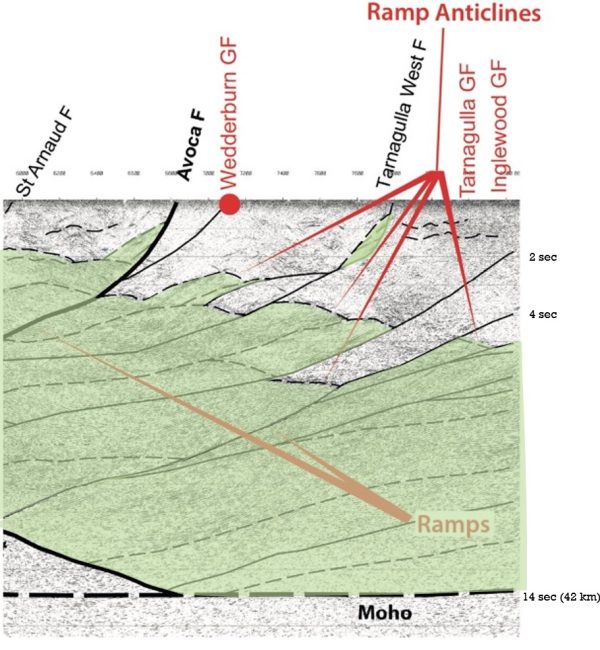
After the 2006 seismic survey was completed, it was possible to test these ideas. It was clear the crust has a dual layered structure, with upper turbidites and lower imbricated Cambrian volcanics. But the models in early late 80s and early 90s advocated for a thin-skinned crustal structure – where faults flattened out to a common horizontal decollement surface. In fact, that was wrong and it turned out to be a thick-skinned terrain where the major faults penetrate to the lower crust. But the faults are listric in profile, that is – steep at the surface and flattening at depth, but they don’t link to a common decollement zone.
But did the survey show a relationship between the location of goldfields and the major faults as suggested by Professor Cox?
It wasn’t immediately obvious from the section. But geologists could see that the Bendigo Goldfield sits above the inflection point of the listric fault. On its own this could be coincidental, but it’s an interesting observation.
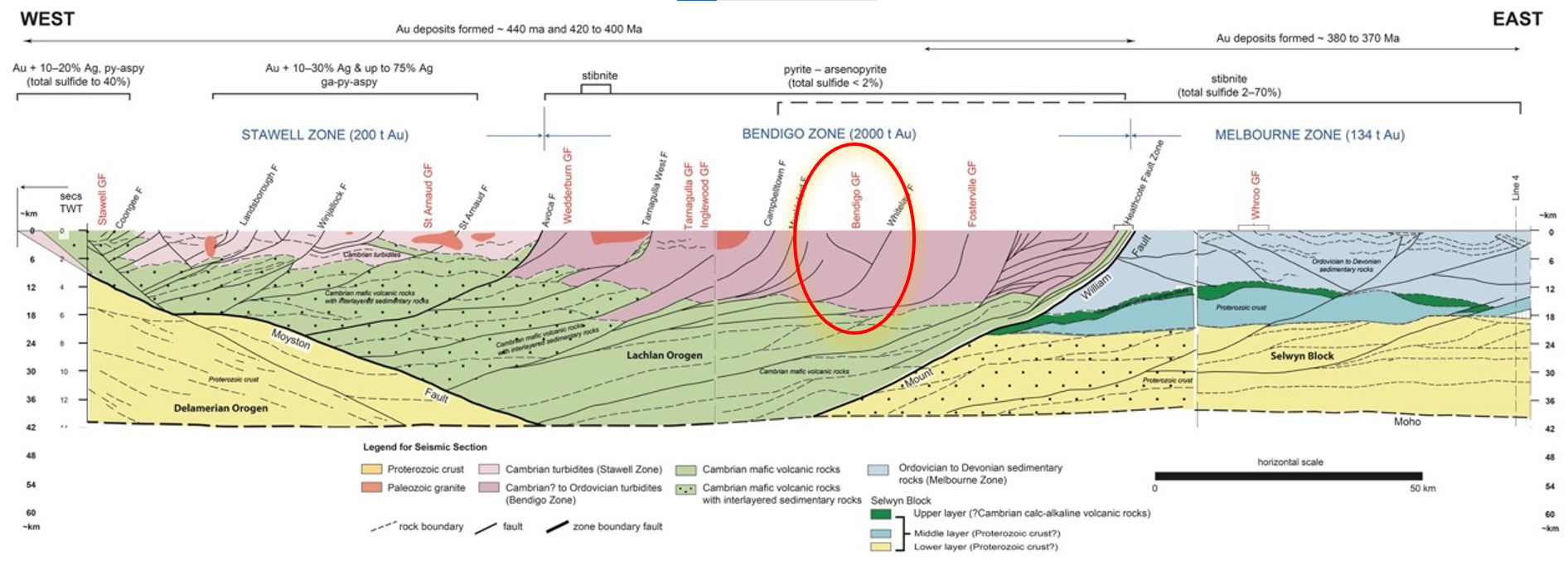
Geologists needed to ask – is there any type of relationship at the surface, that they can see between the goldfield and the fault.
So they went back to mapping that was done 15-20 years before the seismic survey and looked at the fold patterns across the Bendigo and Castlemaine Goldfields using very detailed 10,000 scale mapping conducted by geologists Clive Wilman MSc and David Byrne in the 1980s.
The great thing about Bendigo and Castlemaine is that there is excellent biostratigraphic control by using graptolite fossils. The whole Ordovician sequence is about 3000 metres thick and it’s possible to differentiate different packages of turbidites down to 150 to 200 metres thick.
This is good enough to show the broad structure of the two areas. Here the oldest rocks are the grey colours, the mid-range aged strata are blue, and the youngest strata are orange and yellow. And when a cross-section is drawn across the goldfield to include the Whitelaw Fault a remarkable change in fold style can be seen.
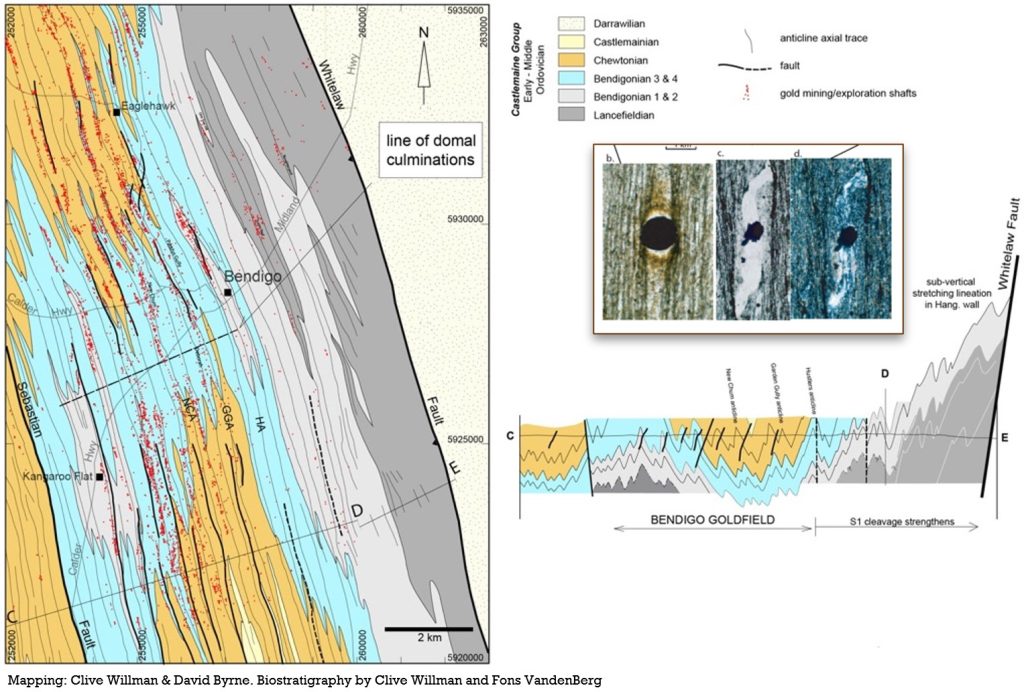
The enveloping surface, of the major fold hinges, is horizontal to synclinal across the goldfield but rapidly climbs towards the Whitelaw Fault. This is simply because the folds have wide west-dipping limbs and shorter east-dipping limbs. So, folds are verging towards the fault and there are other significant features in the hanging wall – such as a vertical mineral lineation, a subtle increase in the strength of S1 cleavage and the slates become almost phyllitic near the hanging wall.
At the same time the folds in the east are slightly tighter. All this suggests a higher overall strain in the hanging wall of the Whitelaw Fault.
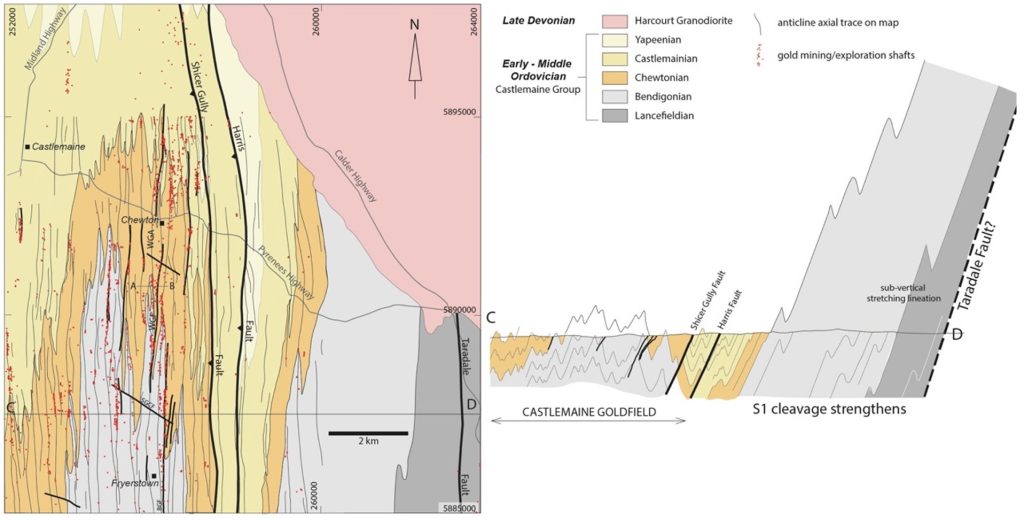
In the same type of section at Castlemaine and Chewton there is an almost identical transition from a flattish enveloping surface which then rapidly climbs east of the goldfield. At the far east end of the section there is similar sub-vertical stretching lineations, and a general eastwards intensification of cleavage and tightening of fold hinges. Unfortunately, graptolites are hard to find in the east and so it’s difficult to identify the presence of a major fault analogous to the Whitelaw Fault. But on the basis of the structures identified, a fault was inferred and named the Taradale Fault – there is some evidence at the surface for the structure.
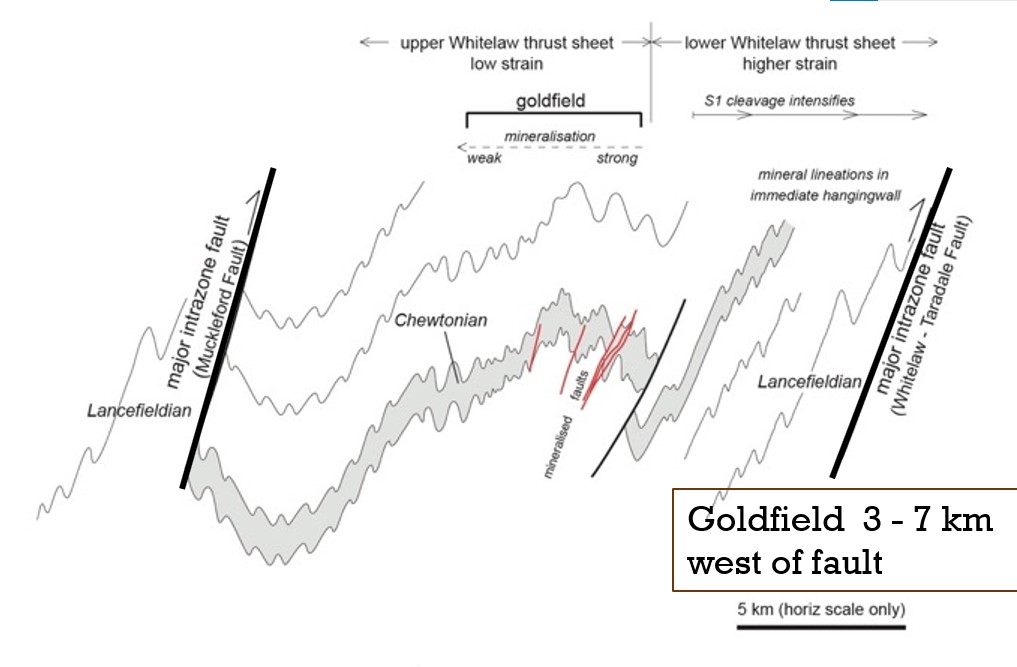
In summary, the relationships in this diagram suggest that folds and major faults may be related, based on fold vergence patterns, and higher strains in the hanging walls of the major faults to the east.
This implies that the growth of the regional faults and folding were partly coeval. Other major faults show similar high strains zones in their hanging walls – the Muckleford Fault, Redesdale Fault, Heathcote Fault Zone and the Avoca Fault.
But importantly, the major intrazone faults are un-mineralised and the goldfield is set back to the west by several kilometres.
But what does the seismic survey tell us about this idea and how could it work?
The observation that Bendigo Goldfield sits above the inflection of Whitelaw Fault is worth considering based on surface relationships – now have a closer look at the seismic section.
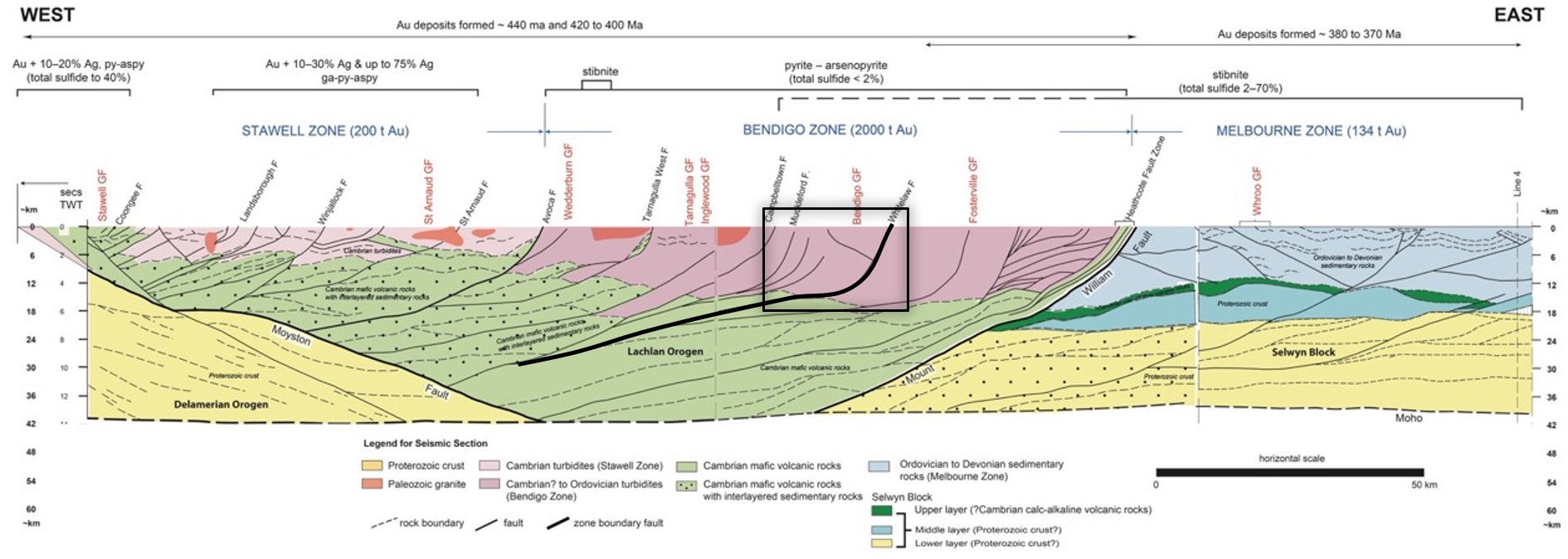
The critical observation here is that faults are listric in profile – that has implications for fluid flow.
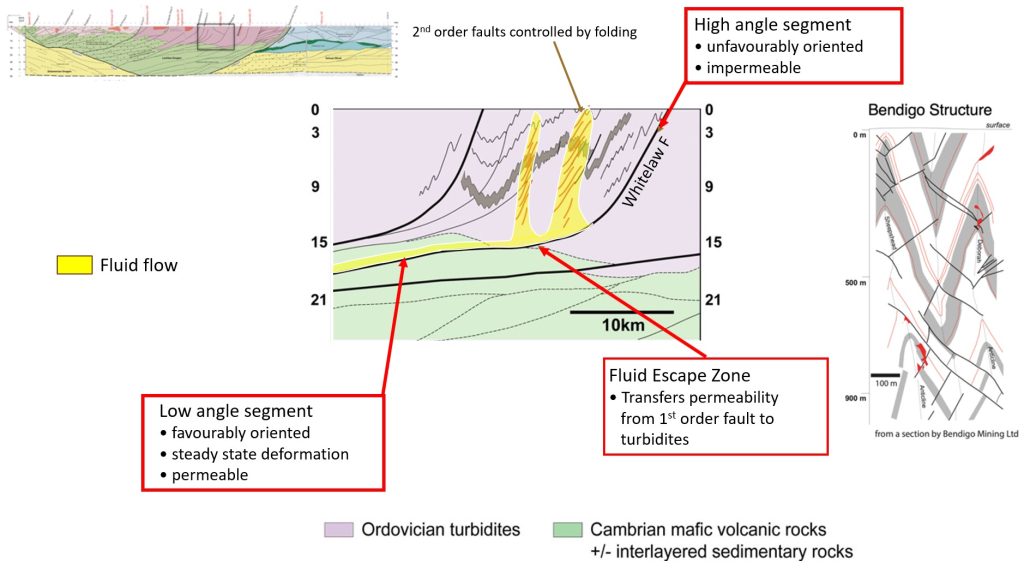
This summarises the relationships between the mapped profile across Bendigo and the shape of the Whitelaw Fault in the seismic survey. Geologists now believe that the low-angle segments of the fault were more effective fluid pathways because they were favourably oriented for reactivation involving steady-state deformation which maintained permeability over an extended period.
By contrast, the high angle segments were unfavourably oriented for reactivation during east-west shortening and were relatively impermeable.
If so, this suggests there was a Fluid Escape Zone that coincided with the steepening of the first-order fault.
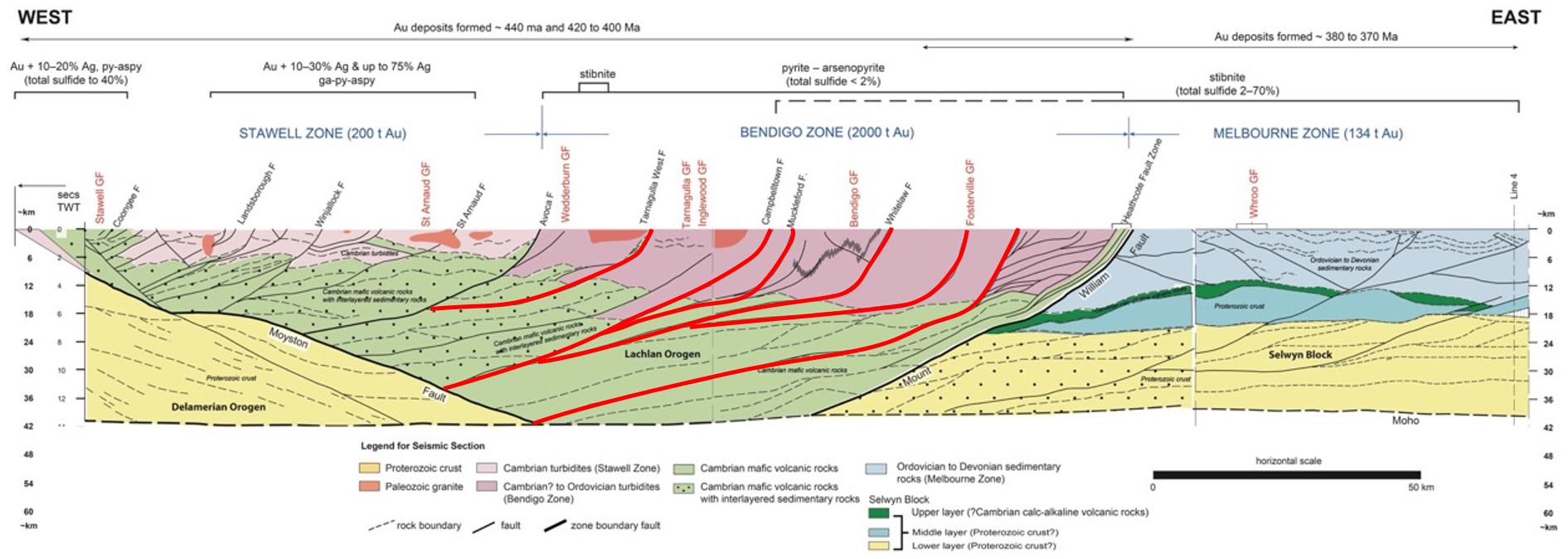
This escape zone represents a transfer of permeability from the major faults, into networks of smaller structures within the folded sediments.
This can help to explain the setback of the goldfields from major faults, and why there is a barren zone.
Plumbing Models
Any Plumbing Model:
- Needs to consider the geometry of the crustal scale structures – are they favourable for fluid flow?
- Needs to account for crustal composition and the level in the crust that the interaction occurs – composition has influenced shortening of lower crust by fault imbrication, compared to folding in upper crust
- The timing and style of deformation – intrazonal faults propagated eastwards over time.
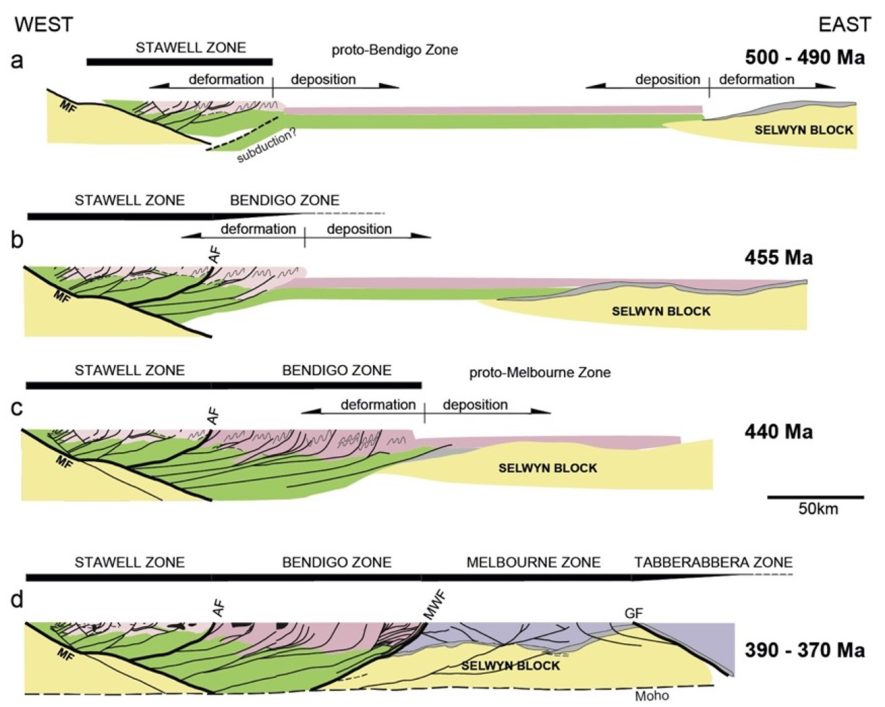
Eastwards progressive deformation has implications for timing of deposit formation.
Are deposits younger in the east?
Gold deposits occur everywhere across the two zones, but there are two areas where production far exceeds other areas – one in the western Stawell Zone and the other in the central to western Bendigo Zone.
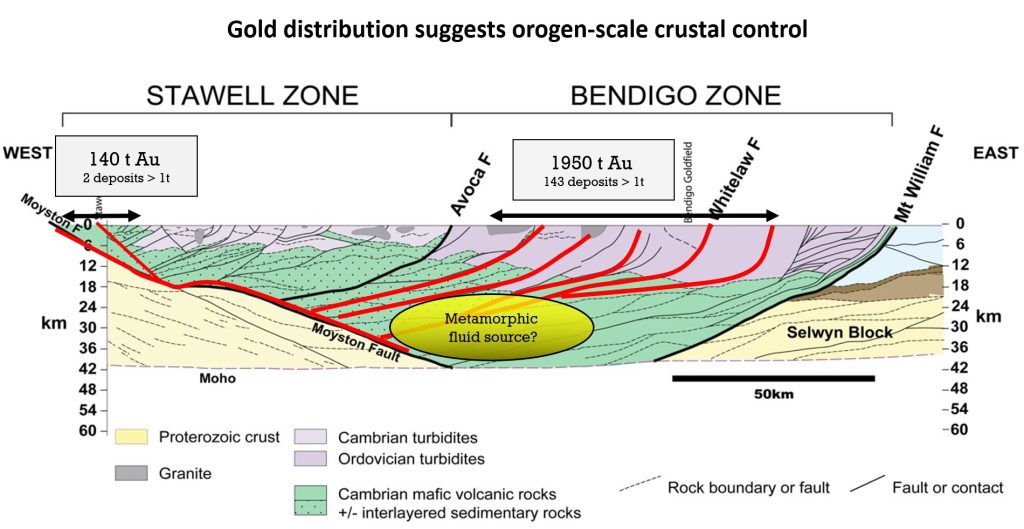
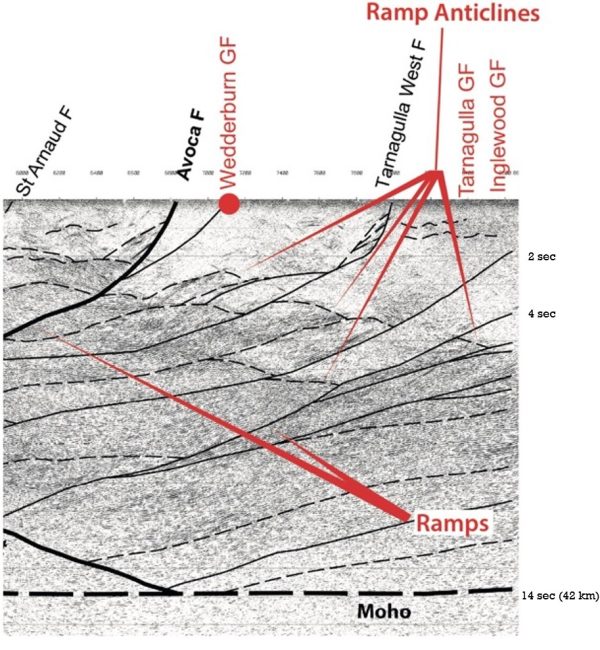
Seismic profiles revealed a pronounced V-shaped geometry with the east-dipping Moyston Fault in the west and the set of west-dipping listric faults farther east.
These structures may have been important fluid pathways that conveyed metamorphic fluids to the two gold regions. If these faults were major fluid conduits it might suggest that the widely separated gold regions shared a common fluid source area.
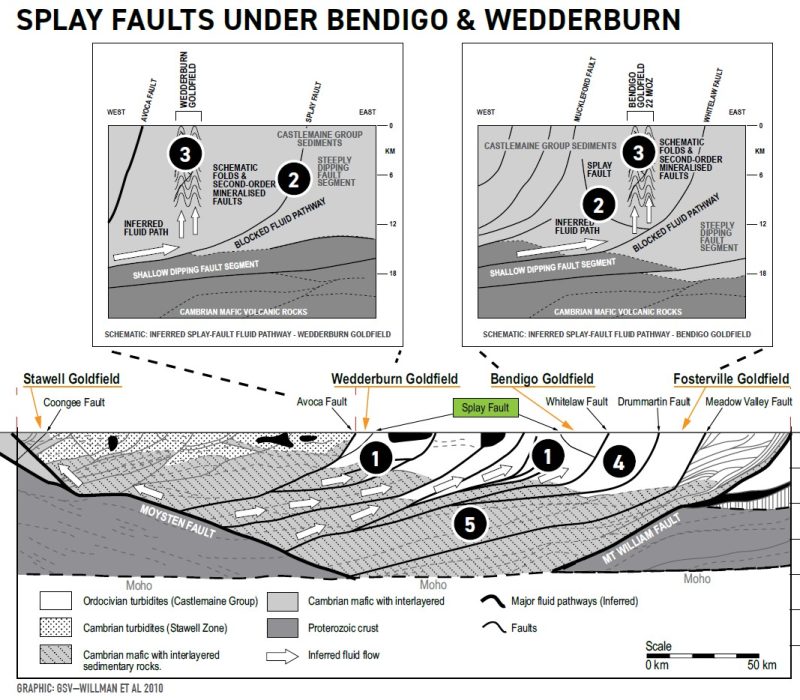
- (1) A common feature of the Wedderburn and Bendigo Goldfields is the splay faults that underlie each field.
- (2) Splay faults are one of the pathways that may have focussed gold-bearing fluids in the vicinity of Wedderburn and Bendigo.
- (3) The vertical pathway of the orogenic gold fluids to the surface at both Bendigo and Wedderburn.
- Castlemaine Group sediments (4) (white) overlaying Cambrian mafic (5) (pale grey) with interlayered sedimentary rocks.
Wedderburn
- ~27 km north of Seismic Line one.
- Sits above a ramp anticline.
- Inferred Cambrian volcanic sequence about 7.5 km below surface.
- Compare with Bendigo where volcanics are about 15 km below surface.