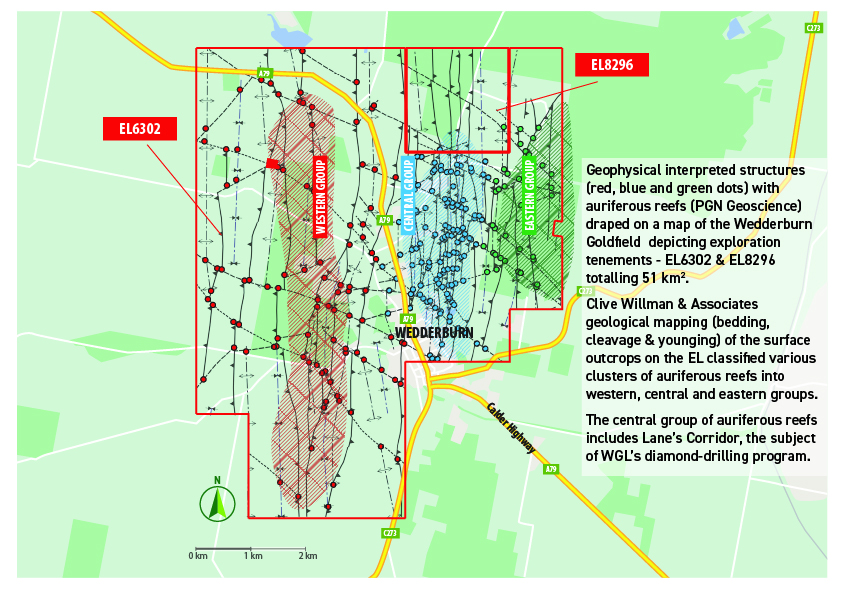
DRILL-READY TARGETS
Victoria’s Gold
Victoria’s recorded gold production since 1851 is 1.5% of all the world’s gold from just 0.03% of the world’s land area.
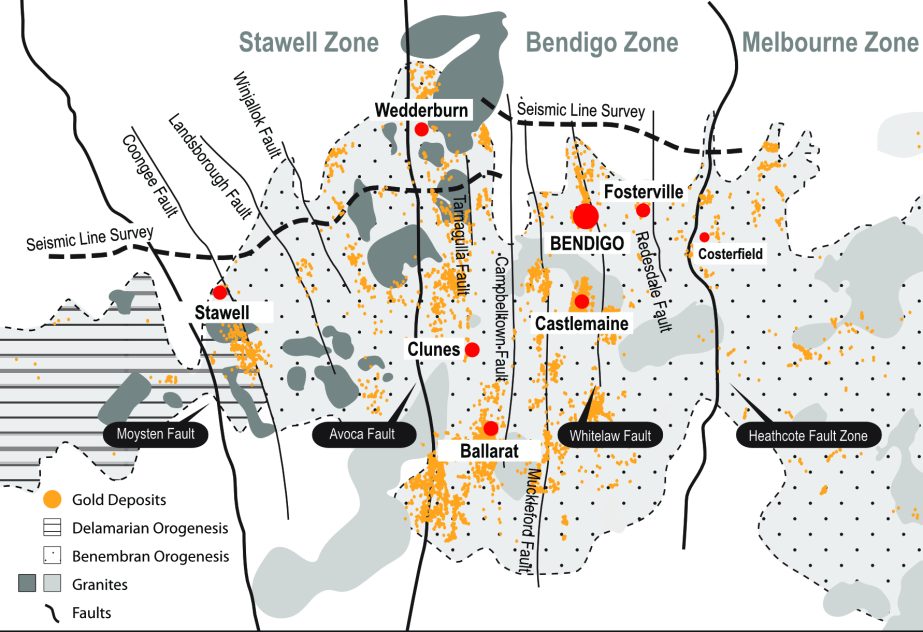
Geological Survey of Victoria estimates the state’s goldfield geology is two orders of magnitude (100 times) richer in gold than the global average and has more than 75 million ounces of gold still to be found and mined. Recent successful mines like those at Fosterville and Costerfield show the high potential of the region.
Modern exploration techniques, including magnetics, conductivity and other geophysics techniques, give an added impetus to exploration and mineralisation research.
Science combined with conviction, persistence and patience is proven to be the key to unlocking Victoria’s golden opportunities – Fosterville has shown the prize is worth the risk.
Wedderburn Goldfield Geology
The Wedderburn Goldfield sits near the western margin of the Bendigo structural zone of Victoria and experienced all three of the zone’s distinct orogenic gold events: 445, 410, and 370 million years ago. The Bendigo Zone has the greatest gold production of all the Victorian geological zones, totalling more than 65 million ounces.
As a result, the Bendigo Zone contains most of the state’s 7,000 historical gold mines in major mining centres such as Bendigo, Ballarat, Castlemaine, Clunes, and the significant modern gold production centre at Fosterville.
Dilation Zone Targets
Folding plays a critical role in gold deposition in Victoria by acting as the primary structural control on the localisation of quartz reefs, creating dilation zones for gold precipitation, and controlling the location of later faults.
WGL is searching for gold in dilation zones. These types of dilation zones have proven to be prolific gold producers in the Bendigo Zone.
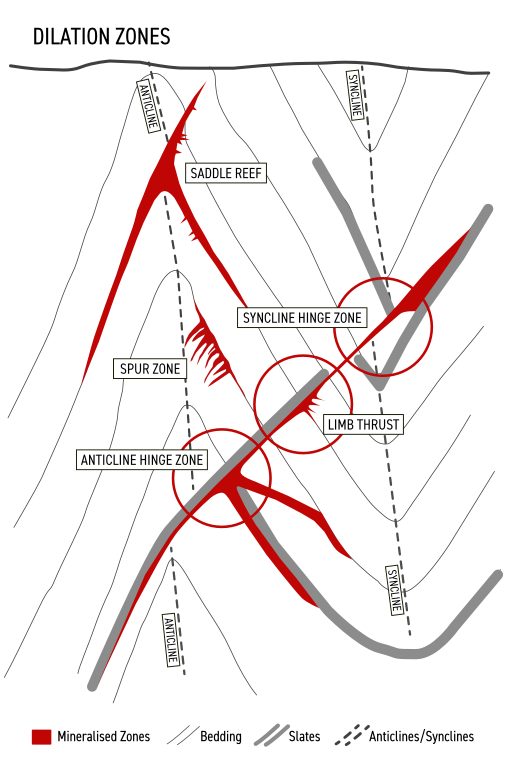
These forms of dilation zones include:
- Hinge zones in anticlines – a very large amount of gold came from these structures in the Bendigo Zone;
- Spur zones (a mesh-like arrangement of quartz-filled tension veins that were often very significant bodies of gold mineralisation) situated between anticlines and synclines; and
- Hinge zones of synclines, a significant feature of the very high-grade Swan Zone at Fosterville.
- Limb thrusts, faults that truncate fold limbs, these structures are common in every goldfield.
Key Aspects of the Role of Folding:
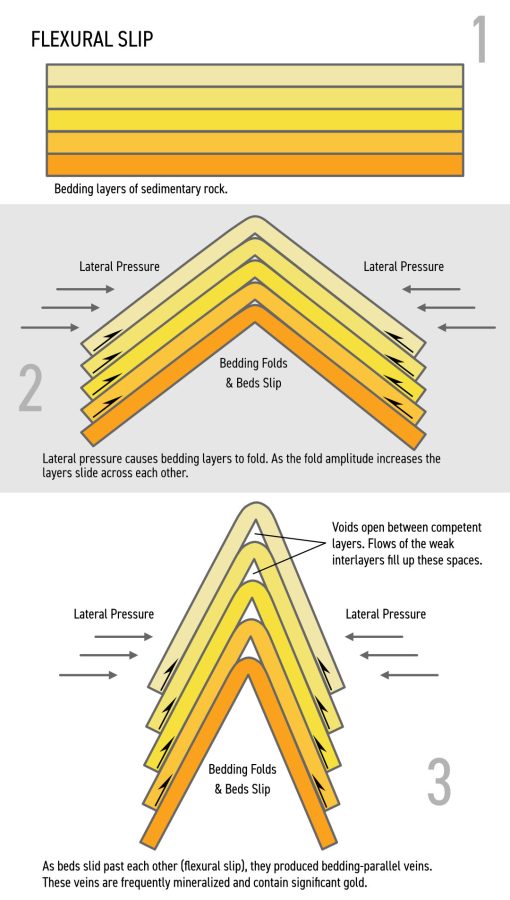
Formation of Structural Traps (Saddle Reefs): During the folding of Palaeozoic sandstone and mudstone, space was created at the hinge points of the folds (the curved parts) where the layers separated. These hinge sites are known as saddle reefs and are major hosts of gold mineralisation.
Flexural Slip and Veining: As beds (layers of rock) were bent, they slid past each other (flexural slip), producing bedding-parallel veins, especially in slate units. These veins are frequently mineralised and contain significant gold.
Creation of Hydraulic Fractures: Tight “chevron-shaped” folding in the Bendigo Zone led to high fluid pressure and high fluid flux, which caused tensile hydraulic fracturing. These fracturing events resulted in the emplacement of auriferous (gold-bearing) quartz reefs.
Control on Later Faults: While much of the gold is found in later reverse faults e.g. limb thrusts, the locations of these faults were highly controlled by the preceding fold structures. Folds acted as a “template” that dictated where subsequent fractures and mineralised fluids would propagate.
Rotation of Stress and Mineralisation: In some areas like Fosterville, gold deposition is associated with a change in the stress field from the initial folding to a later, reactivated faulting phase.
Folding was not just a deformation event, but the fundamental, initial process (around 440–360 million years ago) that produced the necessary structural architecture to trap gold-bearing metamorphic fluids in Victorian quartz reefs.
Wedderburn Goldfield is no different, it features classic bedding-parallel veins, folded about anticlines. There are limb thrusts in the Lanes Reef deposit that cut across a fold hinge, as elsewhere in Victoria.
Target One
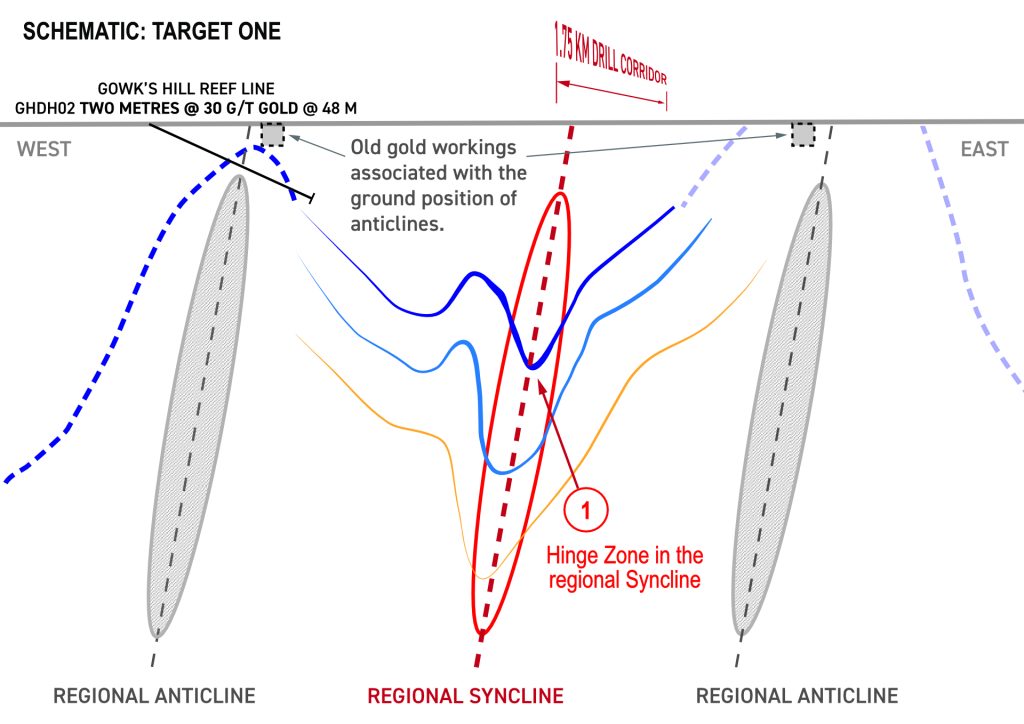
The Hinge Zone in the Regional Syncline
WGL’s new underground interpretation of a regional syncline, with a 1.75 km strike length, allows for future testing of the syncline’s mineralised hinge zone (1).
Target Two
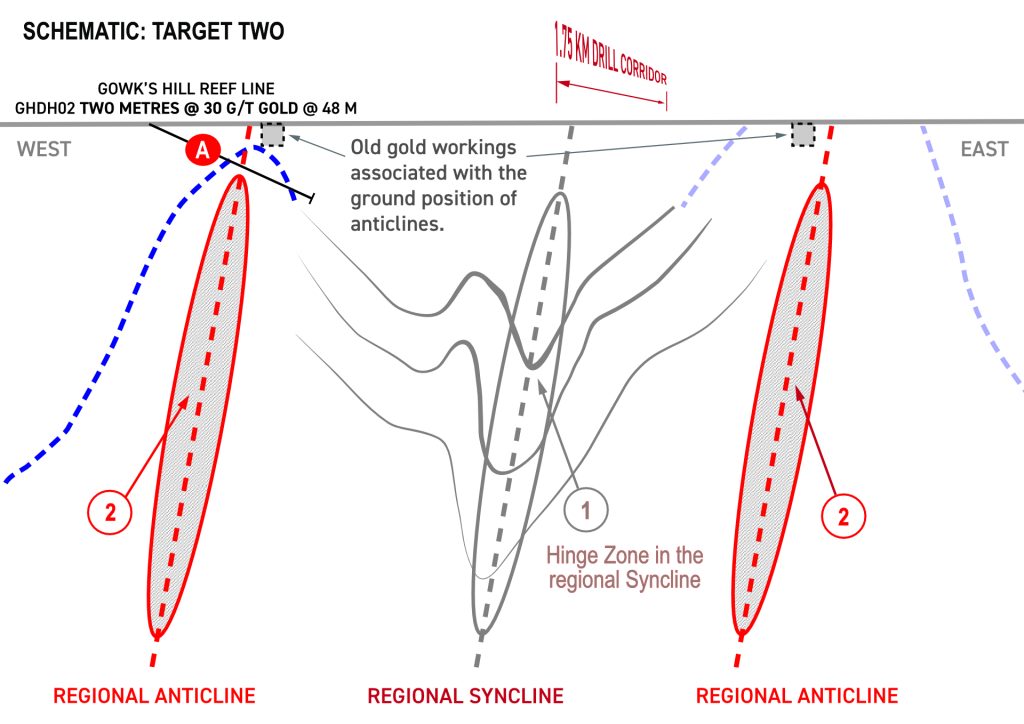
Mineralised Anticline Cross Faults & Drill Hole Intersection
- WGL’s new interpretation of the western and eastern regional anticlines allows for future testing of mineralised hinge zones in the anticlines (2).
- Target Two includes an existing 2 m at 30 g/t intersection at 48 m downhole in the hinge zone on the depicted western anticline (A).
Target Three
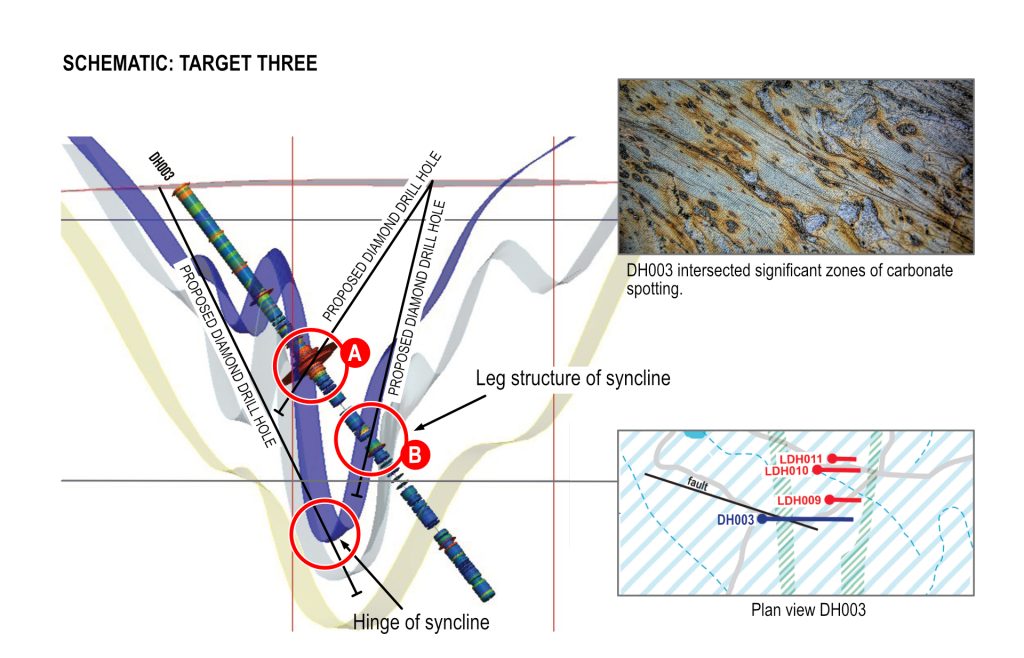
DH003 intersections with a cross fault.
-
- A 30-metre mineralised zone (down hole width) intersected at 152 metres is interpreted as a cross-fault (A).
- The zone (A) is characterized by carbonate spotting and elevated arsenic and is anticipated to be like the sub-vertical Nick O’ Time ore shoot at Tarnagulla .
- A mineralised zone was intersected at a downhole depth of 270 metres (B).
- Carbonate spots are an indicator of gold mineralisation throughout central Victoria (Wilson et al, 2010).
Geophysics
Geophysics identifies 258 targets on WGL’s tenements that warrant further investigation.